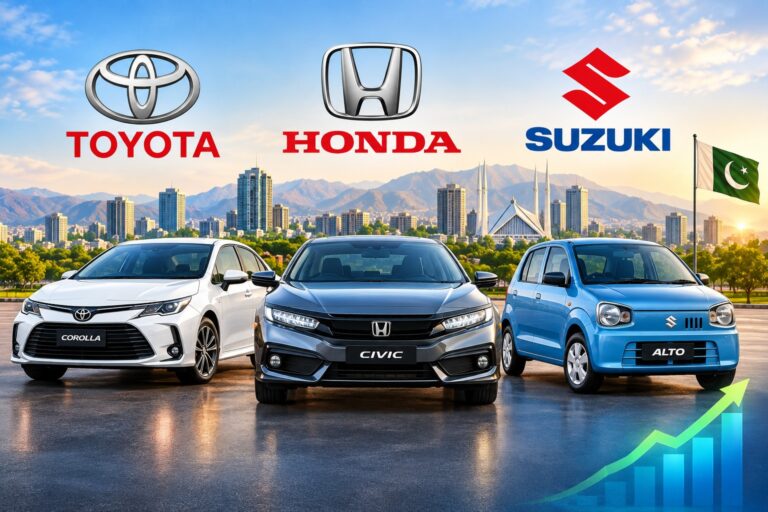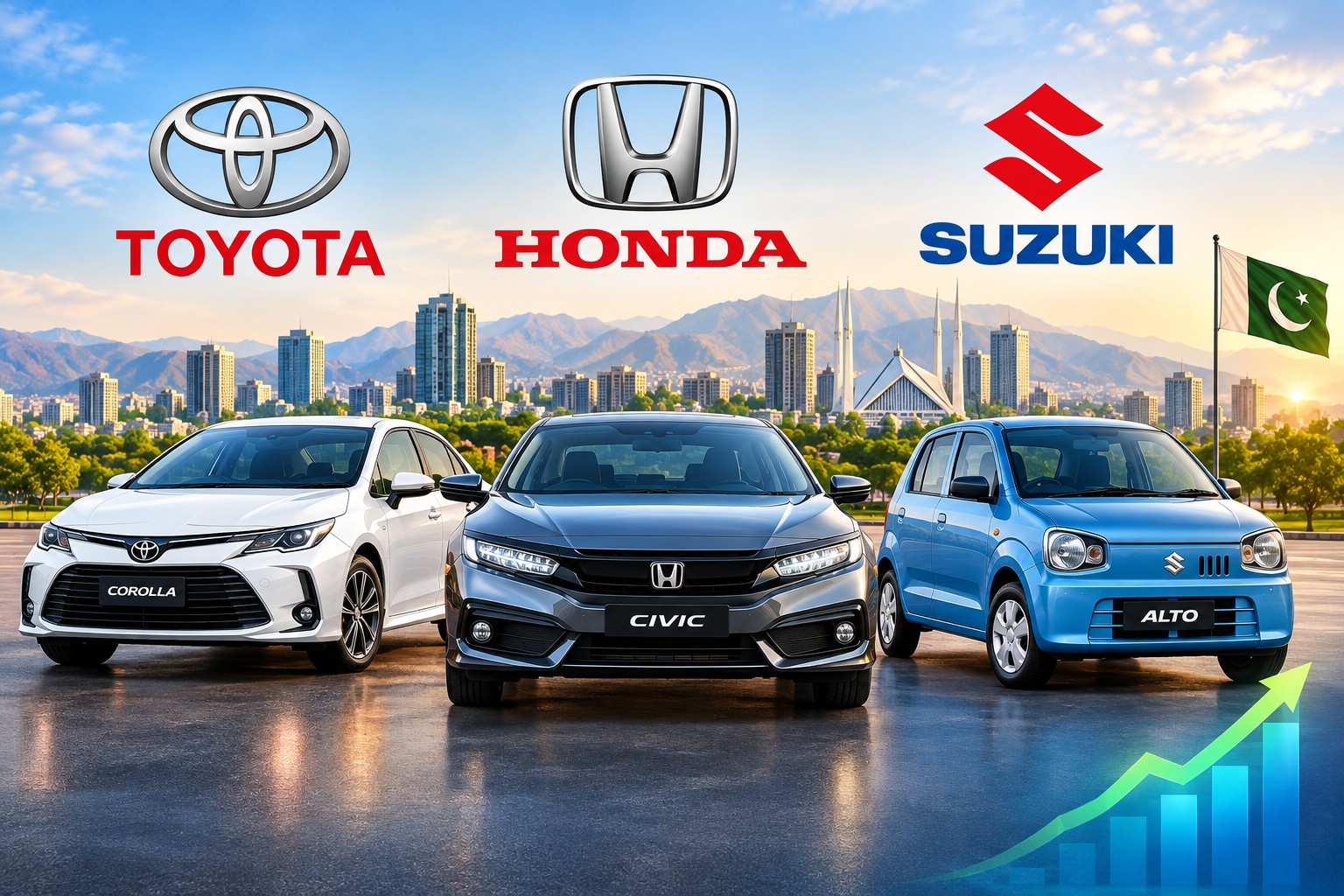
KARACHI — Pakistan’s automobile market continued its recovery in August 2026, with sales by traditional automakers rising 11% year-on-year to 15,558 units, although volumes fell 21% month-on-month from July as uncertainty over the new automotive policy, hybrid and electric-vehicle taxation and regional supply-chain conditions weighed on market activity.
According to data reported by the Pakistan Automotive Manufacturers Association (PAMA), cumulative sales during the first two months of FY2026-27 reached 35,376 units, representing a 41% increase over the corresponding period last year.
The August numbers therefore present a mixed picture: the market is recovering strongly from last year’s depressed levels, but the sharp monthly decline indicates that the recovery remains sensitive to policy, pricing and supply conditions.
Toyota, Honda and Suzuki Post Year-on-Year Growth
Indus Motor Company Limited recorded 4,029 units in August, up 19% year-on-year, although sales declined 21% from July.
The company’s Corolla, Yaris and Corolla Cross models were the principal contributors, with combined sales increasing 21% YoY to 3,079 units. Fortuner and IMV sales also increased 12% compared with August 2025.
Honda Atlas Cars (Pakistan) Limited reported 2,633 units, with sales remaining broadly unchanged from July but substantially higher than the same month last year.
City and Civic sales were particularly strong, reaching 2,529 units, compared with only 699 units in August 2025. This represents more than a three-fold year-on-year increase. However, BR-V and HR-V sales remained weak, falling 79% YoY to only 80 units.
Pak Suzuki Motor Company Limited remained the largest seller among the manufacturers covered by PAMA, recording 7,633 units in August.
Suzuki sales increased 7% year-on-year but declined 25% month-on-month. The Alto remained the company’s key volume driver, with 5,339 units sold, up 27% from August 2025. Cultus sales, however, dropped 40% to 296 units, while Swift sales
Passenger-car sales reported separately under PAMA’s passenger-car classification reached 13,717 units, up 36.4% YoY, while cumulative passenger-car sales for July-August increased almost 80% to 30,933 units.
The difference between the 15,558-unit industry figure and the 13,717-unit passenger-car figure reflects differences in the vehicle categories included in the respective datasets. Investors should therefore avoid directly comparing the two figures without considering their respective classifications.
Despite the recovery, August production also weakened. Passenger-car production stood at 13,267 units, down 23.3% from July, although still 5.4% above August 2025.
Hybrid and EV Policy Remains a Major Variable
One of the most important issues for the industry is the government’s evolving policy toward hybrid and electric vehicles.
Industry representatives have sought clarity on the new automotive policy following the expiry of the previous Automotive Development and Export Policy 2021-26. PAMA has also highlighted uncertainty surrounding taxation of hybrid and electric vehicles as a factor affecting market activity.
This uncertainty is becoming increasingly significant because Pakistan’s automobile market is undergoing a structural change. New Chinese brands, hybrid models and electric vehicles are increasing competitive pressure on traditional assemblers.
For established manufacturers, therefore, higher sales volumes alone may not be sufficient to sustain margins if companies need to respond through discounts, new-model launches or higher spending on localization and technology.
What August Sales Mean for PSX Auto Stocks
The improvement in industry volumes is relevant for listed automobile assemblers, particularly INDU and HCAR, although the impact on earnings will depend on selling prices, product mix, localization, margins, financing costs and exchange-rate movements.
INDU: Toyota Sales Recovery
Indus Motor’s August performance provides evidence of continued demand across its core passenger-car portfolio.
The company’s FY2026 financial statements reported sales of Rs258.75 billion and profit after tax of Rs25.51 billion, compared with Rs215.14 billion and Rs23.01 billion respectively in FY2025. EPS increased to Rs324.50 from Rs292.74.
As of September 10, 2026, PSX data showed INDU at Rs1,846.99, with a reported trailing P/E of 5.69x. The stock’s 52-week range was Rs1,695 to Rs2,300.
For investors following INDU, the key variables going forward are likely to include:
- Sustained recovery in vehicle volumes
- Corolla Cross and other higher-value model sales
- Localization and gross-margin trends
- Dividend distributions
- Currency stability
- Interest-rate and auto-financing conditions
- Competitive pressure from hybrid and Chinese brands
HCAR: Sharp Recovery in City and Civic
Honda Atlas has shown a particularly notable recovery in its core City and Civic portfolio.
The company sold 2,633 vehicles in August, while City and Civic sales reached 2,529 units.
HCAR’s FY2026 sales increased to Rs122.28 billion, compared with Rs78.07 billion in FY2025. Profit after tax rose to Rs3.23 billion, while EPS increased from Rs18.97 to Rs22.64.
PSX data showed HCAR share prices at Rs220.31 on September 10, 2026, with a reported trailing P/E of 6.43x. Its 52-week range was Rs147.50–318.00.
HCAR’s future performance will depend heavily on whether the sharp recovery in City and Civic demand can be sustained, while the company’s weak SUV volumes remain a point to monitor.
PSMC: Important PSX Status for Investors
Although Pakistan Suzuki remains the country’s largest volume seller, investors should note that Pak Suzuki Motor Company (PSMC) is no longer listed on the Pakistan Stock Exchange.
PSMC was delisted from PSX in 2024, meaning its strong August sales performance cannot be directly translated into a current PSX stock-investment opportunity.
This distinction is particularly important for market commentary because Suzuki continues to have a dominant position in Pakistan’s vehicle market even though PSMC is no longer a listed equity.
New Brands Could Reshape the Competitive Landscape
The recovery in traditional auto sales is taking place at the same time that Pakistan’s automobile market is becoming more competitive.
New entrants and Chinese manufacturers are expanding their presence, while hybrid and electric vehicles are gaining consumer attention. This could create a larger overall automobile market but may also reduce the market share historically enjoyed by established Japanese assemblers.
For listed companies such as INDU and HCAR, the investment question is therefore moving beyond simple unit sales.
Market share, product mix, margins, localization, model pipeline and the ability to compete with hybrid and EV offerings will increasingly determine earnings performance.
Outlook: Recovery Underway, But Policy Clarity Needed
Pakistan’s auto market has clearly moved away from the depressed volumes witnessed during the previous downturn. The 41% year-on-year increase in two-month industry sales provides evidence of a significant recovery in demand.
However, the 21% month-on-month decline in August demonstrates that the recovery is not yet entirely stable.
For the PSX, improving automobile volumes could support earnings expectations for listed assemblers, particularly if higher volumes are accompanied by stable margins and stronger consumer financing. Conversely, prolonged policy uncertainty, aggressive competition from new entrants and a rapid shift toward hybrid and electric vehicles could limit the benefits of higher unit sales.
The next few months will therefore be important in determining whether August’s year-on-year growth represents the beginning of a sustained industry recovery or merely a rebound from last year’s unusually weak base.
For investors, the key indicators to watch will be monthly PAMA volumes, company-level model sales, gross margins, quarterly earnings, dividend announcements and developments in Pakistan’s new automotive policy.
About the Author