Pakistan’s automotive industry recorded mixed performance in the first quarter of FY2026-27, with passenger car sales posting strong year-on-year growth while jeep and pickup sales declined. Tractor, truck and motorcycle sales also registered growth, reflecting varying demand trends across vehicle segments.
Passenger Car Sales
Passenger car sales increased 42.8% year-on-year to 41,872 units during July–September 2026, compared with 29,318 units in the corresponding period last year. Production also increased by 31.8% to 47,614 units from 36,114 units.
However, September sales indicated a slowdown in market momentum. Passenger car sales declined 9.8% year-on-year to 10,939 units from 12,126 units and fell 20.3% compared with 13,717 units in August. In contrast, production rose 24.7% year-on-year to 17,040 units, outpacing monthly sales and potentially adding to inventory levels if the divergence persists.
Performance by Engine Capacity
The September slowdown was particularly pronounced in smaller-engine vehicles.
- Below 1,000cc: Sales declined 29.9% year-on-year to 3,812 units from 5,439 units. Suzuki Alto sales fell 28.9% to 3,354 units. Despite the monthly decline, Alto sales remained strong on a cumulative basis, rising 41.6% to 15,910 units during the quarter.
- 1,000cc segment: Suzuki Cultus sales dropped 67.7% to 138 units from 427 units in September last year.
- 1,300cc and above: Sales increased 11.6% year-on-year to 6,947 units. Cumulative sales for the quarter reached 23,605 units, up 52.9% from the corresponding period last year.
Major Automakers and Model Performance
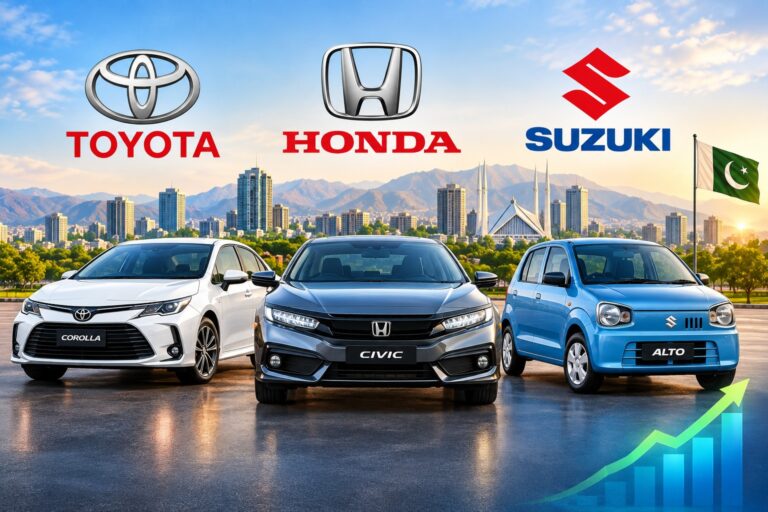
Toyota maintained a strong position in the passenger car market. Combined sales of the Corolla, Yaris and Corolla Cross reached 3,563 units in September, representing a 34.2% year-on-year increase. Cumulative sales for July–September stood at 10,925 units.
Honda Civic and City sales increased 2.2% year-on-year to 2,021 units in September. The company recorded cumulative sales of 7,103 units during the quarter, nearly double the 3,819 units sold in the same period last year.
Suzuki Swift sales, however, declined 39.3% year-on-year to 852 units in September. Nevertheless, cumulative sales remained positive, increasing 27.8% to 4,342 units.
Hyundai Elantra recorded a notable improvement, with September sales reaching 494 units compared with 131 units a year earlier.
In the electric vehicle segment, Dewan Honri-Ve sold 42 units in September, taking cumulative sales to 165 units for the quarter, up from 95 units in the corresponding period last year.
Jeeps and Pickups
The jeep and pickup segment remained under pressure during the first quarter of FY2026-27. Sales declined 33.5% year-on-year to 8,608 units from 12,949 units.
September sales fell 17.5% to 4,165 units compared with 5,048 units a year earlier, despite a 31.1% increase in production to 4,937 units.
Sazgar’s Haval and Tank lineup provided a bright spot, with September sales surging 73.5% year-on-year to 2,474 units. Newer market entrants also recorded sales, with Jetour selling 406 units during the quarter and Suzuki Fronx recording 171 units.
In contrast, Hyundai Tucson sales plunged to 224 units from 1,738 units in September last year. Suzuki Ravi recorded no sales during the month, compared with 2,652 units a year earlier.
Trucks and Buses
The commercial vehicle segment posted encouraging growth in the first quarter. Truck sales increased 53.1% year-on-year to 2,516 units, while bus sales remained broadly stable at 211 units compared with 221 units last year.
Combined truck and bus sales rose 46.3% to 2,727 units, indicating improved demand for commercial transportation vehicles.
Tractor Sales
Tractor sales increased 37.8% year-on-year to 4,109 units during July–September 2026. September sales more than doubled to 1,815 units from 790 units a year earlier.
Massey Ferguson, manufactured by Millat Tractors, accounted for 1,252 units, while Fiat tractors, manufactured by Al-Ghazi Tractors, contributed 563 units during September.
Despite stronger sales, tractor production declined 15.3% over the quarter to 4,203 units, indicating a divergence between production and demand trends in the agricultural machinery segment.
Motorcycles and Three-Wheelers
The two- and three-wheeler segment continued to demonstrate strong growth, with combined sales increasing 28.4% year-on-year to 553,994 units during July–September 2026, compared with 431,542 units in the same period last year.
September sales rose 27.4% year-on-year to 202,502 units, reinforcing the segment’s position as a key driver of Pakistan’s automotive market.
Honda maintained its dominance, selling 470,399 units during the quarter, up 28.3% year-on-year. United Auto motorcycles recorded stronger growth among the major manufacturers, with sales increasing 48.7% to 61,133 units.
Suzuki sold 10,572 motorcycles during the quarter, while Sazgar’s three-wheeler sales reached 7,735 units.
Market Outlook
Pakistan’s automotive industry entered FY2026-27 with strong cumulative growth across passenger cars, tractors, trucks and buses, and two- and three-wheelers. However, September’s decline in passenger car and jeep and pickup sales suggests that demand remains uneven across vehicle categories.
The divergence between production and sales in the passenger car and jeep and pickup segments warrants attention in the coming months, particularly if elevated output is not matched by retail demand. Meanwhile, the continued expansion of motorcycle sales and the recovery in tractor demand provide positive signals for the broader automotive sector.
Overall, the first-quarter figures point to a recovering but uneven automotive market, with future performance likely to depend on consumer purchasing power, financing conditions, vehicle affordability and sustained demand across key segments
About the Author