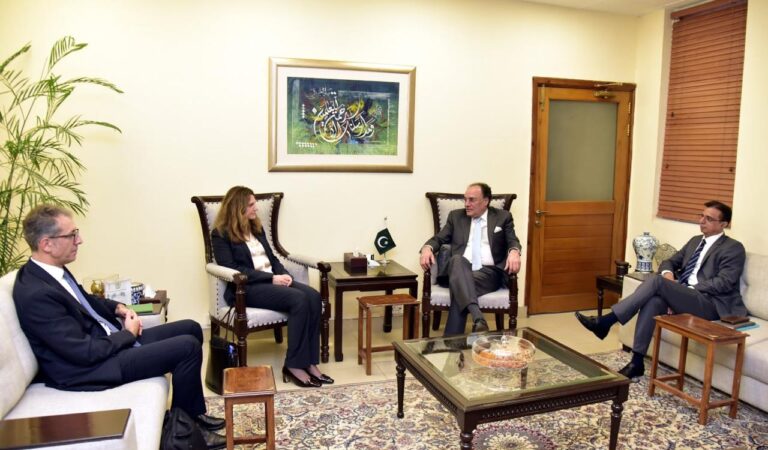
Jameel Ahmad briefs global investors on economic reforms, declining inflation and improved external stability during IMF-World Bank meetings in Bangkok
KARACHI, October 17, 2026: State Bank of Pakistan (SBP) Governor Jameel Ahmad has highlighted Pakistan’s improved economic resilience, citing a sharp recovery in foreign exchange reserves, lower inflation, a gradual revival in economic growth and an improving fiscal position.
The Governor shared these developments during high-level meetings with international investors and financial institutions on the sidelines of the IMF-World Bank Annual Meetings held in Bangkok, Thailand, from October 12 to 17, according to an SBP press release issued on Saturday.
The meetings brought together senior executives from nine major international financial institutions, including JP Morgan, Citibank, Jefferies, Deutsche Bank, Barclays, Bank of America, MSCI, Standard Chartered and Mitsubishi UFJ Financial Group (MUFG). Mr. Ahmad also held discussions with bilateral and multilateral partners, representatives of other central banks and global credit rating agencies, highlighting Pakistan’s recent macroeconomic progress and ongoing reform agenda.
The SBP Governor attributed the improvement in Pakistan’s economic outlook to prudent macroeconomic policies and structural reforms implemented over the past three years, which he said had strengthened the economy’s capacity to withstand domestic and external shocks.
Inflation declined sharply from the elevated levels recorded in FY23 to near the target range in FY26, despite a significant increase in global oil prices. Meanwhile, real gross domestic product (GDP), which contracted in FY23, recovered gradually to grow by 3.7% in FY26. Economic growth is projected to range between 3.5% and 4.5% in FY27.
Pakistan’s external position has also improved considerably. The SBP’s foreign exchange reserves increased from less than $3 billion in February 2023 to $21.5 billion as of October 9, 2026. Over the same period, forward liabilities declined from more than $5.7 billion to less than $1 billion.
According to the central bank, the reserve accumulation was driven largely by its own foreign exchange purchases, while the country’s external debt stock increased only marginally over the past three years.
The Governor said the improvement in the external sector was supported by an almost balanced current account in FY26, which created room for the SBP to purchase foreign exchange and strengthen the country’s reserve buffers. Regulatory reforms, particularly those concerning exchange companies and measures to encourage remittances through formal channels, have also contributed to improved liquidity in the interbank foreign exchange market.
The central bank expects foreign exchange purchases to continue, with Pakistan’s current account deficit projected to remain within 0% to 1% of GDP in FY27.
On the fiscal front, Pakistan recorded its third consecutive annual primary surplus in FY26, supporting a downward trajectory in the public debt-to-GDP ratio.
Mr. Jameel also informed investors that Pakistan had reached a Staff-Level Agreement (SLA) with the International Monetary Fund (IMF) on reviews under the Extended Fund Facility (EFF) and the Resilience and Sustainability Facility (RSF).
He said continued implementation of economic reforms had helped strengthen investor confidence, contributed to improvements in Pakistan’s sovereign credit ratings and facilitated the country’s access to international capital markets despite challenging global financial conditions.
The SBP Governor said Pakistan’s economic fundamentals had strengthened considerably, enabling the country to better absorb external shocks than during previous periods of economic stress. However, he acknowledged that ongoing geopolitical developments continued to pose risks to the economic outlook. He maintained that the policy measures implemented over the past three years had improved the country’s capacity to manage these challenges.
Mr. Ahmad reaffirmed the central bank’s commitment to maintaining macroeconomic stability, strengthening external buffers and advancing structural reforms to support sustainable economic growth.
The meetings provided an opportunity for Pakistan to communicate its economic progress and reform priorities to international investors and financial institutions amid continuing global economic uncertainty
About the Author